From Local Food to Shared Reference Point
According to reputable historical sources, even before the pizza craze reached widespread fame, the pizza and all the condiments used for it saw more or less variation and understanding, given that they developed under constant use so that as long as a pizza variant-rae pepperoni, etcetera - found a place, it would make the locals content. Thus, this variety of spread and culture gives a distinct message as this would sum up most of the history, a clear message of strength and splendor to have passed their lot over.
Migration as a Quiet Carrier of Food Culture
The movement of people played a central role in pizza’s expansion. As migrants relocated for work or stability, they carried familiar cooking habits with them. Pizza did not spread because it was exported in a formal sense, but because it was cooked in homes, small shops, and neighbourhood bakeries. These early versions were often adjusted out of necessity, using local flours, cheeses, or ovens. Yet the structure remained recognisable. Migration allowed pizza to develop new regional identities while keeping a shared foundation, creating variations that felt authentic rather than imposed.
Regional Roots and Everyday Origins
Pizza’s earliest forms were practical rather than performative. Flatbreads topped with simple ingredients were common in many cultures, but what set pizza apart was how firmly it settled into daily life in southern Italy. It was food designed for regular eating, made with accessible ingredients and prepared in ways that suited busy urban environments. This grounded beginning shaped expectations early on. Pizza was not framed as a dish for special occasions, but as something dependable, filling, and shared. That sense of ordinariness would later make it easier for the food to travel, because it did not arrive elsewhere carrying rigid rules or symbolic weight.
Early Adaptation Without Reinvention
In its early international appearances, pizza did not attempt to redefine itself. It changed slowly, responding to what was available and what people preferred to eat. Portion sizes shifted, toppings expanded, and preparation methods adapted to different equipment. These changes were incremental, not radical. Because the core format stayed intact, pizza remained understandable even when it looked different. This balance between adaptation and familiarity helped establish pizza as something flexible but not vague, capable of belonging in many places without losing coherence.
Memory, Familiarity, and Emotional Attachment
The memory of pizza surpasses pure utility or gustatory pleasure. For many people, more frequently than specific recipes, pizza comes to be tied up with specific instances. For instance, childhood meals, late nights, shared boxes left unopened, shared nevertheless. Many a time pizza symbolises ordinary occasions when a relationship is established beyond pretence with an underlying emotion that ebbs in joy never acknowledged. Its acculturation into existence knows no fanfare; its effect is mostly felt in retrospect. People come back to pizza not just because it is comforting and convenient but because they relate to it so innately in terms of history.
The Role of Cities, Work, and Routine
Pizza grew in cities, where volume was key-an urban environment full of people was one where long hours and common premises crying out for fast shareable food mattered. Somehow, pizza was in perfect step with all that.
As cities grew, and thus did the lifestyle of the go-getter, pizza became the minimum schedule rather than the original schedule as in a fancy one. Thus, pizza became positively viewed for the masses, notwithstanding any hotspot.
Urban Density and Shared Eating Habits
Cities created demand for food that could be prepared efficiently and eaten collectively. Pizza suited this need well. It could be sliced, shared, and eaten without formal structure, making it ideal for group settings. In workplaces, schools, and social gatherings, it functioned as a neutral option that required little explanation. This adaptability allowed pizza to embed itself into urban life, where convenience mattered but social connection still played a role in eating habits.
Work Patterns and Time Constraints
As working hours became more structured, meals needed to fit around schedules. Pizza’s preparation and serving style aligned with these constraints. It could be ordered, shared, and consumed without disrupting the rhythm of the day. Over time, this practicality shaped how people thought about pizza. It became associated with breaks, late evenings, and informal gatherings. These associations travelled with the food itself, reinforcing its role as something reliable rather than indulgent or ceremonial.
Consistency Across Different Social Settings
One of pizza’s strengths is how comfortably it moves between contexts. It appears at family tables, office meetings, and casual celebrations without changing its meaning too much. This consistency reduces friction. People rarely need guidance on how to approach pizza or when it is appropriate. That predictability has helped it maintain relevance across generations, as new settings emerge but the basic expectations remain the same.
Local Preferences and the Shape of Change
Reflected of the acceptance that its global spread had offered to the locals in whose communities pizza has been burgeoning-the origination of local tastes and practices into the essence of pizza must not be mistaken as debasement but as a full integration. For every local person, pizza was always geared up to a systematized version of what they were already eating and enjoying.
An element of change was extant, but yet there was pizza. The crust confronted the heat while the toppings provided room for alteration but would still deliver a pizza in the end.
Ingredients as Cultural Translation
Local ingredients often defined how pizza evolved in different places. Cheeses with different textures, sauces adjusted for regional palates, and toppings drawn from familiar cuisines all played a role. These choices made pizza feel less foreign and more integrated into existing food cultures. Importantly, the changes rarely challenged the structure of the dish itself. Instead, they worked within it, allowing people to recognise pizza even when the flavours were new.
Eating Customs and Social Norms
How pizza is eaten varies widely, from quick individual meals to long shared occasions. These differences reflect broader social norms around dining. In some places, pizza is a fast solution; in others, it is part of extended social time. The food accommodates both approaches. Its form does not dictate behaviour, which allows it to adapt to local customs without resistance. This flexibility has helped pizza remain relevant even as dining habits change.
Boundaries That Keep the Idea Intact
While pizza changes, it does so within understood limits. The presence of a baked base, a topping layer, and a balance between components acts as an anchor. These boundaries prevent the dish from becoming something else entirely. Because of this, debates about what belongs on pizza persist without threatening its identity. The conversation itself reinforces shared understanding, reminding people that they are still discussing the same basic food.
Commercial Expansion and Standardisation
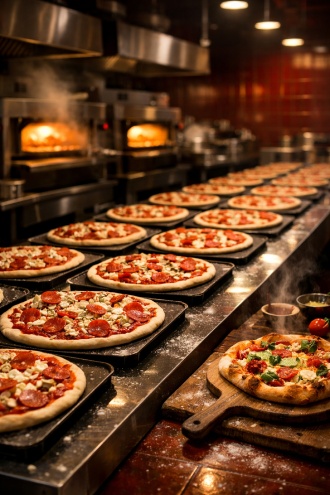
The so-called standardization of the ways of pizza production and distribution would-henceforth-eager to make it cost-prohibitive and, instead, introduced the new variables in which stability and promptness became what was expected.
This phase did not obliterate regional or rural interpretations-the latter emerged as parallel realities. Made possible with the existence of mass-produced and local pizza.
Scaling Without Losing Recognition
Large-scale production required simplification and repetition. Recipes were adjusted for reliability, and processes were designed to be replicated across locations. Despite this, pizza remained immediately recognisable. Even highly standardised versions retained the visual and structural cues people associated with the dish. This recognisability ensured that expansion did not come at the cost of comprehension.
Consistency as a Form of Trust
Standardised pizza offered predictability. Knowing what to expect reduced decision-making and built trust with consumers. This consistency did not replace personal preference but provided a baseline. People could choose familiarity or seek variation, depending on context. The availability of both options strengthened pizza’s overall presence rather than weakening it.
Independent Spaces and Ongoing Experimentation
Alongside commercial growth, small-scale producers continued to experiment. Independent kitchens explored technique, fermentation, and ingredient sourcing without redefining the dish. These efforts kept pizza connected to craft and locality. The coexistence of experimentation and standardisation ensured that pizza remained both accessible and open to refinement.
Why Pizza Continues to Hold Its Place
The struggle between openness and convention is such that one finds pizza exceedingly dated but yet so uncannily current. Pizza has surrendered airs and graces but maintains its redeeming purpose.
Shared Understanding Across Borders
Few foods are as widely understood as pizza. This shared understanding reduces barriers. People know what pizza is supposed to be, even when they disagree on details. That common ground makes pizza an easy point of connection, especially in mixed or unfamiliar settings. Its recognisability supports communication as much as consumption.
Flexibility Without Loss of Meaning
Pizza’s ability to change without losing meaning is central to its endurance. Adjustments happen at the surface level, while the underlying structure remains intact. This allows the food to respond to trends and preferences without becoming dependent on them. When tastes shift, pizza adapts quietly rather than reinventing itself.
Common Threads in a Global Food
Pizza has a list of common traits, which justify being global rather than becoming once a for all.
- Simple structure allowing for variety
- Methods of preparation familiar and with relative trust apart from each other
- Eating ways are acceptable for scores of occasions: from camping to parties to quite formal dinners
- Local ingredients that represent regional identity
- Clear boundaries of identities to keep the pizza from dissipating
The Long Life of Something Ordinary
Once pizza had conquered the world, it was not the grand schemes but the tiny forces which played a role. So there were the migrations of the pizzas, as they rose from being daily bread to things overwhelmingly popular and loved in certain localities, to being the simple comfort food for this merchant. Therefore, the pizza did many things, yet remained useful. It never became outdated or overcooked. Primarily, more than anything else, there was aloof improvement, allowing this familiar wonder food to live on and on pretty much the same without trying to reinvent itself.